
GaussianBlurGenerator#
- class deepinv.physics.generator.GaussianBlurGenerator(psf_size, sigma_min=0.5, sigma_max=5.0, isotropic=True, angle_min=0.0, angle_max=360.0, num_channels=1, rng=None, device='cpu', dtype=torch.float32)[source]#
Bases:
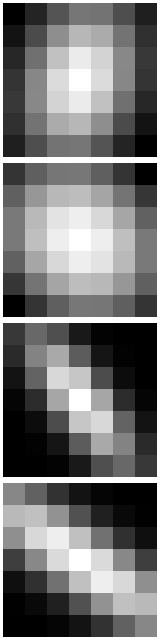
PSFGeneratorRandom Gaussian blur generator. Generates 1D, 2D, or 3D Gaussian kernels with random standard deviations and rotation angles.
- Parameters:
psf_size (tuple[int, ...]) – the shape of the generated point spread function (PSF). The dimension (1D, 2D, or 3D) of the kernel is determined by the length of the
psf_sizetuple.sigma_min (float | tuple[float, ...]) – the minimum standard deviation(s) for the Gaussian kernel. If a single value is provided, it is applied to all dimensions. If a tuple is provided, it should have the same length as the number of dimensions and specify the minimum sigma for each dimension.
sigma_max (float | tuple[float, ...]) – the maximum standard deviation(s) for the Gaussian kernel. Follows the same format as
sigma_min.isotropic (bool) – If True, the generated Gaussian kernels will be isotropic (same sigma for all dimensions). If False, the kernels can be anisotropic (different sigma for each dimension). Defaults to True.
angle_min (float | tuple[float, ...]) – the minimum rotation angle(s) for the Gaussian kernel in degrees. For 2D kernels, this is a single angle of rotation in the plane. For 3D kernels, this can be a tuple of three angles (alpha, beta, gamma) representing minimum rotation values around the x, y, and z axes respectively. In 3D, if a single angle is provided, it is used as minimum value for all axes.
angle_max (float | tuple[float, ...]) – the maximum rotation angle(s) for the Gaussian kernel in degrees. Follows the same format as
angle_min.num_channels (int) – number of images channels. Defaults to 1.
rng (torch.Generator) – PyTorch random number generator for reproducibility. If
None, a torch.Generator will be created on the specified device.device (str) – the device to create the tensors on. Defaults to “cpu”.
dtype (type) – the data type of the generated tensors. Defaults to torch.float32.
- Examples:
>>> import deepinv as dinv
>>> rng = torch.Generator(device="cpu").manual_seed(0)
>>> generator = dinv.physics.generator.GaussianBlurGenerator((7, 7), device="cpu", rng=rng, isotropic=False)
>>> params = generator.step(batch_size=4)  # dict_keys(['filter'])
>>> dinv.utils.plot(params['filter'])